
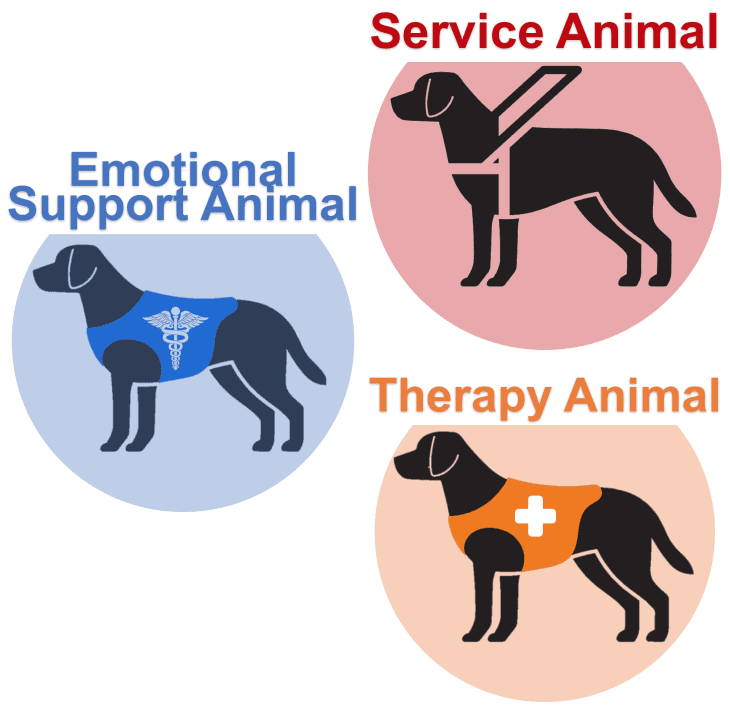
Service Dogs, Emotional Support Animals & Therapy Animals
A complete resource: definitions, legal rights (ADA, FHA, ACAA), training & behavior expectations, documentation guidance, best practices, and how to qualify.
Overview
This guide explains differences between Service Animals, Emotional Support Animals (ESAs), Assistance Animals, and Therapy Animals; clarifies rights under ADA, FHA, and ACAA; and provides practical advice for handlers, landlords, businesses, and institutions.
Service Animals — Definition & Scope

 Service Animals are individually trained animals—usually dogs, and sometimes miniature horses—that perform specific tasks to mitigate a person’s disability. Unlike companion animals, service animals perform work directly related to a disability and are considered working animals rather than pets.
Common disabilities and tasks
Service animals help people with:
- Visual impairments: Guide dogs
- Hearing impairments: Alert dogs
- Seizure disorders: Seizure-alert/response dogs
- Diabetes: Glycemic alert dogs
- Mobility impairments: Mobility-assist dogs (brace, retrieve)
- Psychiatric disabilities: Psychiatric service dogs that interrupt panic attacks, ground a handler during dissociation, or retrieve medication
What makes a service animal “legal”
The key factor is task-based training. The handler must demonstrate that the animal reliably performs tasks that directly mitigate the disability. Documents, vests, or “certificates” sold online do not create legal qualification—training and observable behavior do.
ADA public access rules — quick summary
- Service animals are allowed in most public places (restaurants, stores, hotels, transit) subject to safety and control rules.
- Staff may ask only: (1) is the animal required because of a disability, and (2) what work or task has the animal been trained to perform.
- Staff may not ask for medical documentation or require demonstration of tasks.
Handler responsibilities
- Maintain control and supervision of the animal
- Keep animal housebroken and under control
- Ensure up-to-date vaccinations and health care
Emotional Support Animals (ESAs)

 Emotional Support Animals provide comfort and therapeutic benefits by their presence. ESAs are not required to perform specific tasks and therefore do not qualify as service animals under the ADA. Their primary legal protection is under housing law (FHA).
Who benefits most from ESAs?
People living with anxiety, depression, PTSD, panic disorder, or other mental health conditions often find consistent companionship and emotional regulation benefits from ESAs.
Housing protections (Fair Housing Act)
Under FHA, landlords must provide reasonable accommodation for assistance animals (service animals and ESAs) when a tenant has a qualifying disability and the animal is necessary to afford the tenant equal use and enjoyment of the dwelling.
- Landlords may request reliable documentation if the disability or need is not obvious.
- Pet fees and breed bans are often waived for ESAs (damage liability still applies).
- Tenants should provide a legitimate ESA letter from a licensed provider when requested.
Travel & public access
ESAs do not have ADA public access rights and are treated as pets in public settings. Airline carriage policies for ESAs have tightened in recent years; handlers should check carrier rules and plan in advance.
Therapy Animals — Programs & Benefits

Therapy Animals are trained to provide comfort and support to groups of people in institutions — such as hospitals, schools, and care homes. Therapy animals are invited guests of programs and are not classified as service animals or ESAs for legal access.
Where therapy animals work
- Hospitals and rehabilitation centers
- Schools and classrooms
- Long-term care and assisted living
- Disaster response and community outreach
Training, certification & liability
Therapy animals often complete temperament testing and obedience training through organizations such as Pet Partners or Therapy Dogs International. Institutions usually require proof of vaccination, handler training, and background checks for volunteers.
Laws & Rights: ADA, FHA & ACAA

Americans with Disabilities Act (ADA)
The ADA covers service animals used by people with disabilities for public access and employment. It sets limits on what businesses may ask and ensures most public accommodations must allow service animals.
Fair Housing Act (FHA)
The FHA requires housing providers to make reasonable accommodations for assistance animals (service animals and ESAs) so that tenants with disabilities can fully use and enjoy housing. Requests must be evaluated through an interactive process, and documentation may be requested if the disability is not readily apparent.
Air Carrier Access Act (ACAA)
The ACAA governs air travel accommodations. Passenger rules differ for service animals and ESAs — airlines typically accept trained psychiatric service dogs (if they meet the service definition) but treat ESAs under pet policies. Below is a compact airport/travel guidance section.
ACAA: Air Travel Guidance & Psychiatric Service Dogs
Psychiatric Service Dogs (PSDs) are service animals trained to perform tasks that mitigate psychiatric disabilities such as PTSD, severe anxiety, or panic disorder. PSDs may be permitted in the aircraft cabin under the ACAA and DOT rules when passengers follow airline requirements for documentation and behavior.
For a smooth travel experience:
- Contact the airline at booking and confirm their current service-animal policy.
- Complete any required airline forms for service animals (some carriers require pre-flight forms).
- Bring proof of vaccinations and a concise training summary where required.
- Ensure the animal remains well-controlled and fits at the passenger’s feet during the flight.
Tip: policies change—always verify with the airline before booking.
How to Qualify — Steps for Service Dogs & ESAs
Qualifying a Service Dog
- Confirm you have a disability that substantially limits major life activities.
- Identify the specific task(s) a dog can perform to mitigate the disability.
- Choose a training pathway: professional school, nonprofit trainer, or owner-train.
- Train for public access, distraction management, and task reliability.
- Keep records of training milestones and health/vaccine documents.
Qualifying an ESA
- Undergo a clinical evaluation by a U.S.-licensed mental health professional.
- If appropriate, obtain an ESA letter that documents the need for an assistance animal for housing accommodation.
- Provide the ESA letter to housing providers as part of a reasonable accommodation request.

Start a screening to learn whether you qualify for an ESA or a service-animal accommodation.
Documentation & Proof — What Helps (and What’s Not Required)
Service Animals
The ADA does not require documentation, registration, or certification for service animals. Yet, maintaining records (vaccination, vet records, training summaries) is helpful for travel, housing discussions, and workplace accommodations.
ESAs (Housing)
An effective ESA letter should be:
- From a U.S.-licensed mental health professional
- Include date, license number, and provider contact (signature)
- State the need for the ESA as a reasonable accommodation (without revealing detailed clinical facts)
Therapy Animals
Therapy teams commonly obtain organization-issued credentials and liability coverage. Institutions often require volunteer registration and proof of vaccination for the animal.
Best Practices for Handlers, Landlords & Businesses
Handlers
- Keep vaccinations current and carry vet records where useful
- Train for public access, obedience, and reliable task performance
- Have concise documentation (training summary, emergency contact)
- Be proactive in housing requests and respectful in public interactions
Landlords & Housing Providers
- Follow the interactive process when assessing accommodation requests
- Request only necessary documentation and protect tenant privacy
- Clarify policies on damage responsibility and allowable restrictions
Businesses & Staff
- Train staff on the two-question ADA rule
- Have a clear escalation path for disputes
- Provide reasonable accommodations when possible and consistent with policy
Frequently Asked Questions
Does an ESA have the same rights as a service dog?
No. ESAs do not have ADA public access protections. They do have housing rights under FHA when properly documented.
Can a business ask for proof?
Under ADA, staff may only ask two questions: whether the animal is required because of a disability and what task the animal performs. They cannot demand documentation or demonstration of the task.
Can landlords charge pet fees for ESAs?
No — reasonable accommodations for assistance animals are typically exempt from pet fees, though tenants may be liable for damage.
Is online certification valid?
Be cautious. Paid online “certificates” without a clinician evaluation or training do not create legal rights. Landlords and employers may scrutinize these documents.
What to do if your request is denied?
Document the request, engage in the interactive process, consult local fair housing agencies, and consider legal advice if necessary.
Click above to see if you qualify for a Service Dog or ESA.
What exactly are the Differences between Service, Emotional Support, and Therapy Animals?
Many people commonly confuse or interchangeably misuse the terms service animal, emotional support animal, assistance animal, and a therapy or psychiatric animal. The key to understanding these differences pertains to three important U.S. federal laws: Americans with Disabilities Act (ADA), Air Carrier Access Act (ACAA), and Fair Housing Act (FHA).
Definitions
Service Animal is defined by the Americans with Disabilities Act (ADA) as “dogs or miniature horses that are individually trained to do work or perform tasks for people with disabilities” (Section 504, Department of Justice summary of service animals based on their 2010 updates to the ADA regulations). Click here for more frequently asked questions pertaining to service animal and the ADA law.
 Emotional Support Animal is defined the Air Carrier Access Act (ACAA) as “any animal that is individually trained or able to provide assistance to a qualified person with a disability; or any animal shown by documentation to be necessary for the emotional well-being of a passenger (§14 CFR Part 382).
Assistance Animal is defined by the Fair Housing Act (FHA) as “an animal that works, provides assistance, or performs tasks for the benefit of a person with a disability, or provides emotional support that alleviates one or more identified symptoms or effects of a person’s disability” (FHEO Notice 2013-01). Thus an assistance animal is the general term for either a service animal or an emotional support animal.
Therapy Animal is commonly defined as an animal, usually a dog/canine, that may be formally trained to provide comfort to individuals in schools, hospitals, retirement homes, nursing homes, etc. None of the three laws already mentioned apply to a therapy animal.
Summary Chart
This chart distinguishes between these the different terms and identify the applicable federal laws:
 |
 |
 |
|
|
Definition |
trained to do work or perform tasks for people with disabilities | provide emotional well-being of for people with disabilities |
trained to provide comfort to individuals in specific environments |
|
Applicable Federal Laws |
|
 |
Only State & Local Laws Apply |
|
Type of Animal |
Dog or Miniature Horse (Psychiatric Service Dog) |
Any Animal |
Any Animal |
|
Should Be Certified or Registered |
 |
|
|
|
Must Have Documentation Identifying the Disability |
|
|
 |
|
Animal Must Be Leashed and Thethered at All Times |
|
|
|
|
Allowed in No-Pet Housing |
|
|
|
|
Able to Have in Public Places |
|
|
|
|
Travel in the Cabin of an Airplane |
|
|
|
| Must Wear a Leash or Vest Identifying the Animal |
|
|
|
 Not Always Required